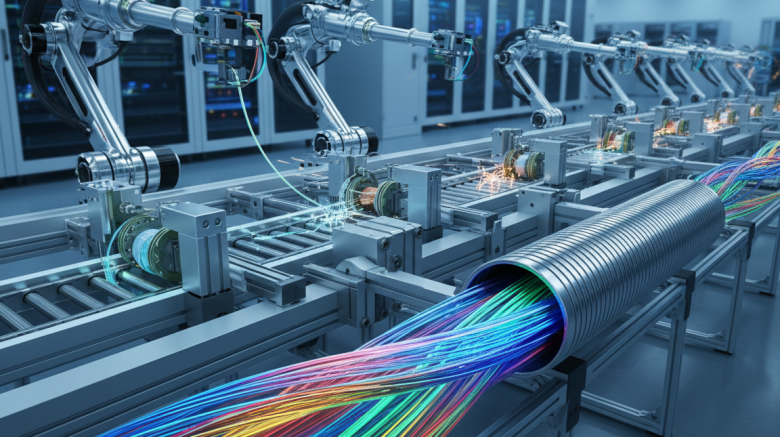
An FTTH Cable Production line is an integrated set of modules that turns glass fiber into finished drop and distribution products with consistent, repeatable quality.
Compact Fiber Unit
This overview helps plant managers, process engineers, sourcing teams, and students in the U.S. who review how factory manufacturing systems converts fine fiber into durable cables for broadband service and communications networks.
At its core, the full-chain objective is simple: safeguard the fiber, maintain low optical loss, provide pull strength for installation, and deliver a product that survives both indoor and outdoor environments.
Professional-grade equipment provides stable tension control, synchronized motion control, consistent process operating windows, and clear, auditable documentation for acceptance testing. This guide helps pair the right line configuration, materials, and test plan to the target product instead of ordering equipment first and backfilling requirements afterward.
You’ll map stages such as fiber prep, buffering and coating, stranding, strength-member integration, sheathing (outer-jacket extrusion), optional armor, and final testing and packaging.
Key takeaways: A well-specified line cuts defects and keeps delivery schedules predictable. Align the process before buying machines to avoid wasted time and expense.
How A Fiber Optic Cable Production Line Operates Today
Where last-mile drop and distribution requirements meet shop-floor execution.
Today’s fiber manufacturing lines turn delicate glass into finished products used in United States broadband buildouts. Last-mile drop cable and ftth drop demand drives high volumes, so manufacturers emphasize consistent handling and standards compliance.
Core Modules, Material Flow
Material follows a clear sequence: pay-off → guiding + tensioning → secondary coating and coloring → organization and SZ stranding → strength-element feed → jacketing/sheathing → cooling and curing → take-up plus testing.
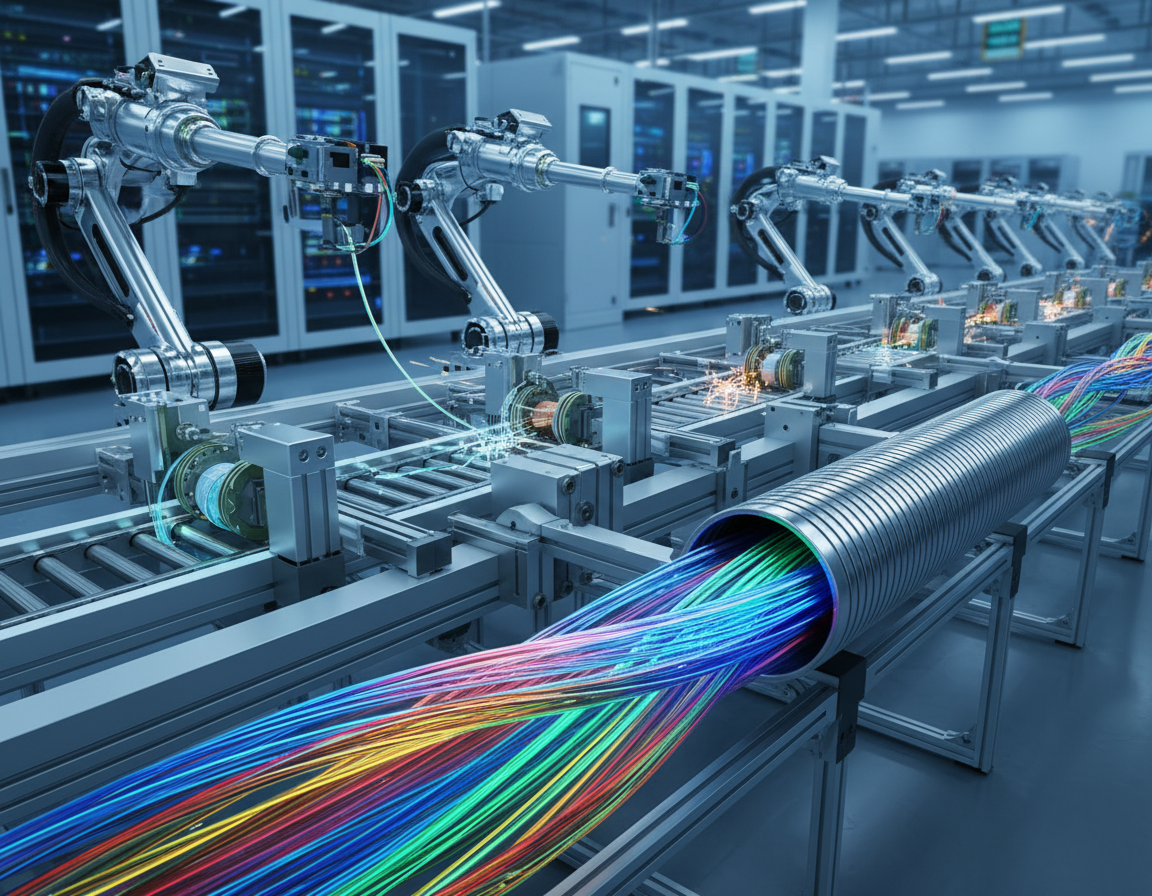
Modules And Outcomes
Stable fiber handling lowers attenuation and protects signal integrity for data and communications. Consistent jacketing aids installation and connector preparation. Inline monitors catch loss events before reels leave the line.
- Indoor vs. outdoor: different jacket compounds and buffering.
- Armored designs add steel tape or wire for added crush and rodent resistance.
- Drop designs favor tight-buffered fibers and simplified connector prep.
Buyers should treat lines as modular systems. Plants add armoring or skip steps to fit the product type. Throughput limits come from curing and dimensional control, not just motor speed.
Define Your Product & Data Standards Before Equipment Purchase
Kick off with a clear product definition that spells out cable type, core count, service environment, and end-use scenarios. Early definition limits which modules the line needs, from tight-buffer units to SZ stranding and jacket extrusion systems.
Select Standards & Measurable Targets
Choose fiber standards such as ITU-T G.652D single-mode or bend-insensitive G.657 A1/A2 based on bend requirements and routing constraints. Define loss budgets, tensile targets, crush and bend limits, and environmental durability before choosing a supplier.
- Map the exact product type and core/fiber count to define modules and control needs.
- Set loss budgets and strength targets to steer material selection.
- List required materials (buffer polymers, jacket compounds) and verify U.S. sourcing availability.
Data Standards, Traceability & Validation
Translate targets into factory information: logged process variables, lot-level traceability, and customer-required acceptance test reports. Plan R&D pilot runs to validate settings and shorten scale-up time.
Fiber Coloring Machine
| Target | Manufacturing Implication | Typical Action |
|---|---|---|
| Minimal attenuation | Tension and alignment control | Inline attenuation checks |
| High strength | Strength member selection | Aramid or metal integration |
| Bend resistance | Fiber selection | Use G.657 variants |
Build Quality Into The Optical Fiber: Core, Cladding, And Coating Essentials
High-quality optical performance starts in the glass, where core purity and cladding design set the limits for signal loss.
Core and cladding make up the core layer structure: a solid, ultra-pure silica core transports light while a lower-index cladding keeps it confined. This geometry is the foundation for low-loss transmission and stable optic behavior in finished cables.
From Preform To Drawn Glass Fiber
Production starts with preform laydown and consolidation. Removing moisture in a high-temperature furnace reduces defects that drive loss upward.
The draw step pulls glass into a micron-scale strand. Geometry control at this stage directly supports stable attenuation and predictable transmission performance. A single blank can yield roughly 5 km of fiber, so process stability saves time and cost.
Primary Coating, Color Coding
Primary coating protects against scratches and handling damage; it is not the primary strength element. Color ID makes splicing, troubleshooting, and downstream fiber management easier.
- Preform consolidation: remove contaminants and moisture.
- Draw: control diameter and tension to keep loss low.
- Coating and color: protect and identify each fiber.
| Layer | Function | Buyer Verification |
|---|---|---|
| Core | Carry light with minimal attenuation | Specify purity and loss specs |
| Optical cladding | Confine light and control modal behavior | Verify index profile and geometry |
| Coating (primary) | Scratch protection; color ID | Verify adhesion and color coding |
FTTH Cable Production: Step By Step Line Setup From Buffering To Sheathing
A workable line setup moves each fiber from pay-off through buffering, stranding, and the outer jacket to a finished reel.
Secondary coating and fiber coloring stations apply dual-layer UV-cured coatings (≈250 µm) and one-to-twelve-channel color coding for tracking and traceability. Consistent UV cure rates and steady web tension reduce mix-ups and rework.
Buffering, Materials
Tight buffering (600–900 µm) improves handling and simplifies connector work. Choosing Hytrel, PVC, or LSZH changes flexibility, temperature range, and flame/smoke behavior.
SZ Stranding, Organization
SZ stranding uses alternating lay to balance geometry and improve cable flexibility. Servo control for up to 24 fibers keeps lay pitch consistent and reduces attenuation risk.
Strength Members & Jacketing
Aramid yarn is the common tensile element; it delivers pull strength without stressing fibers during installation.
Next comes outer jacket extrusion with PVC, PE, or LSZH. Speeds typically range 60–90 m/min and require tight OD and concentricity control.
Armoring And Control Points
If crush or rodent resistance is needed, add steel tape or wire armor with adjustable tension control. Operators track tension, cure state, concentricity, OD, and cooling to maintain quality.
| Process Step | Key Control Point | Typical Value |
|---|---|---|
| Secondary coating process | UV cure & tension | ≈250 µm, consistent cure |
| Tight buffer stage | Choice of material | 600–900 µm (Hytrel/PVC/LSZH) |
| Sheathing/jacketing | OD/concentricity | 60–90 m/min typical |
Optimize Production Speed & Process Control With Modern Automation
When factories run for 24/7 output, synchronized controls and tension systems become the backbone of reliable manufacturing.
PLC, HMI, Closed-Loop Tension For Steady Operation
Modern lines use Siemens PLC + HMI platforms to synchronize modules, manage recipes, and record process information. Closed-loop tension control protects fiber during start, stop, and speed changes.
Fiber Secondary Coating Line
Match Speed To Curing & Dimensional Control
Line speed often tops out when curing, cooling, or extrusion dimensional control can’t keep pace. UV cure completeness, water-trough stability, and chiller capacity define the real limit.
Layout, Changeover, And Procurement
Factory layout affects uptime: proper pay-off/take-up placement plus protected fiber paths reduce damage and shorten changeovers.
- Use quick-change tooling and documented setup steps to speed changeovers.
- Specify industrial power (380 V AC ±10%) and a typical ≤55 kW load when ordering equipment.
- Demand remote diagnostics, spare parts availability, and fast service response from the equipment company.
| Priority | Operational Benefit | Typical Standard |
|---|---|---|
| Synchronization | Less scrap, more repeatable runs | Siemens PLC/HMI platform |
| Tension control | Protects fiber; keeps loss stable | High-accuracy closed-loop |
| Layout/changeover | Reduced downtime | Quick-change tooling and staging |
Testing And Quality Control To Reduce Loss And Improve Delivery Reliability
Robust testing and clear quality control turn raw fiber into reliable, field-ready cable reels.
Start with optical validation. In-line attenuation testing plus return loss checks confirm signal performance before reels ship.
Optical Checks And Signal Integrity
Attenuation testing is the key guardrail against performance issues. Higher loss readings often indicate handling damage, microbends, or contamination.
Return loss checks target reflections that affect sensitive links and tight network margins.
Mechanical & Environmental Validation
- Tensile pull tests validate strength members and safe installation loads.
- Crush and bend tests simulate real-world stresses during installation.
- Temperature cycling, moisture soak, and vibration testing de-risk outdoor and aerial deployments.
| Test Type | Why It’s Done | Typical Decision |
|---|---|---|
| Attenuation | Measure loss per km | Pass/fail against specification |
| Mechanical tests | Confirm pull/crush/bend performance | Installation suitability rating |
| Environmental | Simulate field conditions | Durability confirmed |
Traceability links raw material lots, in-line data, and final test results to reel IDs. Correct reeling, labeling, and protective packaging preserve quality and speed customer acceptance and delivery.
Wrap-Up
A clear manufacturing plan ties product targets to the exact line modules and control limits needed for reliable output. Specify the FTTH product, service environment, and measurable specs before selecting equipment or finalizing layout.
Fiber optic fundamentals—core, cladding, and coating—set the optical baseline. Careful handling upstream preserves signal integrity and keeps finished quality within acceptance limits.
Configure buffering, organization/stranding, strength members, and jacket choices to fit installation realities. Use automation and closed-loop controls to maintain speed, reduce scrap, and keep delivery predictable in U.S. markets.
Discipline matters: use comprehensive testing, reel-level traceability, and documented quality systems so customers can accept reels fast. Next step: translate these points into a purchasing checklist (spec targets, utilities, layout, and acceptance tests) before requesting quotes or conducting trials.
Related: Top Manufacturers Of Fiber Secondary Coating Line Equipment